Posts

Understanding Gait Disorders: When Walking Becomes a Challenge

Image
Gait disorders refer to any abnormality in the way a person walks. These abnormalities can range from subtle changes in stride length to significant difficulties with balance and coordination. Common Types of Gait Disorders: Spastic Gait: Stiff, shuffling walk with legs crossing or dragging. Often seen in conditions like cerebral palsy or stroke. Ataxic Gait: Uncoordinated, unsteady walk with a wide base of support. Common in conditions like cerebellar disorders or vitamin B12 deficiency. Parkinsonian Gait: Slow, shuffling walk with reduced arm swing and difficulty initiating movement. Characteristic of Parkinson's disease. Sensory Ataxia: Unsteady gait due to loss of sensation in the feet, making it difficult to gauge position and balance. Antalgic Gait: Limping gait caused by pain, often due to conditions like arthritis or nerve compression. Causes of Gait Disorders: Neurological Conditions: Stroke, Parkinson's disease, multiple sclerosis, spinal cord injury, brain tumo...

Epilepsy Awareness Begins with Us: International Epilepsy Day

Image
  International Epilepsy Day is on the second Monday of every February, which reduces the stigma associated with the condition, enhances the quality of life in people living with epilepsy, and raises awareness on the subject of epilepsy. What is Epilepsy? Epilepsy is a neurologic disorder characterized by recurrent seizures. A seizure is an abnormal, excessive discharge of electrical activity in the brain. Important Facts about Epilepsy: Epilepsy is seen across all ages, racial groups, and ethnic origin. It is one of the most common neurological disorders affecting nearly 50 million people across the globe. Of these, there are dozens of distinct types of seizures, with different characteristics. Epilepsy can be treated through the adoption of certain medications, lifestyle management, and in some cases, surgery. Breaking Away the Stigma One of the main objectives of International Epilepsy Day is to break the stigma that surrounds epilepsy. Myths and misconceptions about epilepsy le...

Sleep Apnea and Neurological Health: The Connection

Image
  Sleep apnea disrupts sleep, leading to daytime struggles like slow thinking, difficulty learning, and memory lapses. What is Sleep Apnea? Sleep apnea is a sleep disorder where breathing repeatedly stops and starts during sleep. These pauses can range from a few seconds to minutes, occurring multiple times throughout the night and disrupting restful sleep. Types of Sleep Apnea There are three main types of sleep apnea: Obstructive Sleep Apnea (OSA): This is the most common type. It occurs when the muscles in the back of your throat relax and block your airway, preventing air from reaching your lungs. Central Sleep Apnea (CSA): This happens when your brain fails to send the correct signals to the muscles that control breathing. Complex Sleep Apnea (CSA): This is a combination of both obstructive and central sleep apnea. Symptoms of Sleep Apnea Recognizing the signs of sleep apnea can be crucial for seeking timely treatment. Common symptoms include: Excessive daytime sleepiness: ...

Carpal Tunnel Syndrome: Numbness and Tingling in Your Hands

Image
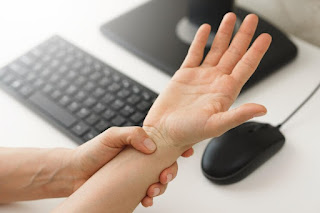
  "Don't let carpal tunnel syndrome cramp your style. Find relief and regain your hand function." What is Carpal Tunnel Syndrome? Carpal tunnel syndrome happens when a main nerve in your wrist gets squeezed. Imagine a crowded hallway where people are bumping into each other. That's what happens to the nerve in your wrist with carpal tunnel syndrome. Anatomy of the Wrist and Hand Your wrist is like a tunnel with a tight fit. Inside, there's a nerve called the median nerve, which controls movement and feeling in your hand. How Carpal Tunnel Syndrome Occurs Overuse or injury can cause swelling in the wrist. This extra pressure squeezes the median nerve, leading to symptoms like numbness and tingling. Symptoms: Your Hand's SOS Numbness and tingling: Often in your thumb, index, middle, and part of your ring finger. Pain: Can start in your hand and travel up your arm. Weakness: Difficulty gripping or holding things. When to sound the alarm: If these symptoms di...

Spinal Stenosis: Understanding the Causes of Back Pain and Leg Weakness

Image
  "Spinal squeeze!" That's what spinal stenosis feels like. It's when the passage for your spinal cord gets too tight, causing discomfort. Imagine your spine as a busy highway. Spinal stenosis is like a traffic jam where the road gets narrower, causing cars (your nerves) to get stuck. This congestion leads to discomfort and delays. Spinal Stenosis: A Quick Guide What is it? Spinal stenosis is when the spaces in your spine become narrower, squeezing your spinal cord and nerves. Where does it happen? Most common in the lower back (lumbar) and neck (cervical) areas. What causes it? Usually from wear and tear, but can also be from injuries or other conditions. What are the symptoms? Back or neck pain, numbness, tingling, and weakness in arms or legs. Who's at risk? Mostly people over 50, but anyone can get it. Anatomy of the spine Your Spine: A Sturdy Tower Your spine is like a tower made of building blocks called vertebrae. These bones are stacked on top of each oth...